Common misconception: “No mans land”. There is no such thing in pickleball like there is in tennis. Get comfortable in the transition zone. Attacking if the ball is high, resetting if it’s low. Short hopping balls in transition zone.
Hot take from this guy and I have to agree. “There is no split steps in pickleball”.
“The minute you split step, your chest goes back, your contact point gets late, and you pop the ball up. Colin Johns said it best, ‘it’s about accelerating and decelerating as you move up”.
Dekel Bar says the same thing here:
Instead, stay low and take some small steps to creep in to the kitchen. Have patience. You can’t avoid the transition zones, it’s okay to be in the transition zones for many shots. Sure you want to get in there with little shots as possible, but be patient. Dekel says he averages 2-4 shots to get in.
Chop Steps On Closeouts
Don’t do abrupt stops, it’ll “spill the water bottle” like Zane says. If you split step, will almost always “spill the water bottle”.
What you see pros doing is, they do the choppy steps at the end. Like when a basketball player closes out on a guy on the three point line, they run and then when they get close they shuffle step.
Basically this allows you to explode to either side if they dink wide to the side. And if they pop it up, you can still close on it and attack.
- Like a basketball defender closing out on the three point line. The defender can still go to either side if the offense tries to drive in and the defender can still jump up to block if the guy shoots the ball.
Drive and follow through forward. Momentum forward.
- Instead of having your follow be through to the side turning your shoulder.
- Why? This way your momentum goes forward. So you don’t have to uncoil after you drive, which takes away valuable time getting through the kitchen and forces you to rush.
- This is sort of a hot take, to instead of following through to your shoulder, follow through forward. I had this take as well and was glad to find someone who had a similar thought process. Pickleball isn’t tennis or table tennis, that valuable time to uncoil is way more important in Pickleball.
Transition Zone Movement: How Should You Move After Dropping The Ball.
Your Non-ball dropping Partner has ideally moved up to the kitchen. So opponent will want to keep the ball away from your partner and thus likely dink/flick out wide.
This means 90% of the time, after dropping, you should cover the sidelines and let your off-ball partner cover the middle.
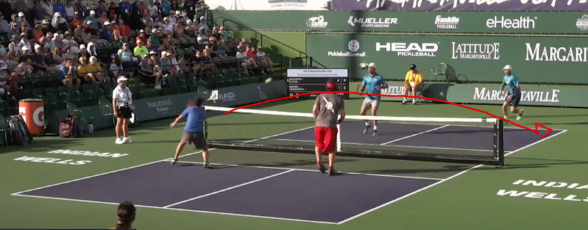
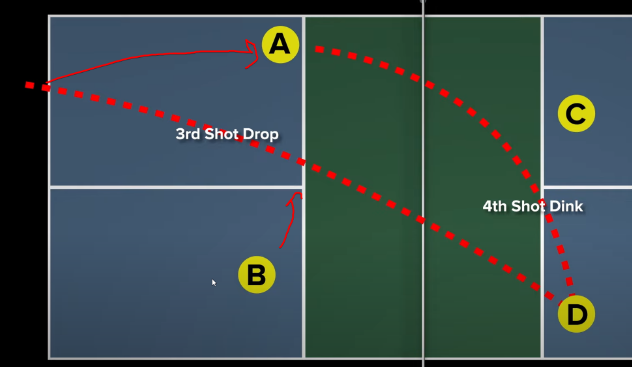
The off-ball person should cover most of the court and cut off angles so the dropper can come in down the line.
Move With Your Paddle In Front Of You
“Does this ever happen to you where in transition they drive at you and you hit the ball [late] into the net?” – Tanner
Run with your arm out in front, this way you won’t have a timing issue and can just place the paddle to block if they drive at you in transition. Instead of having to move the arm forward and time hitting the ball.
- Don’t have your arm stretched too much out in front though, otherwise there is no power and you’ll just hit the ball into the net. Don’t have your arm fully straight. He says it should be fully extended, that is incorrect/an exaggeration, you can’t have control/softness or power if your arm is fully extended.
Priority Checklist
- Maintain low body height
- so you can maintain balance when you contact the ball and also be able to attack lower balls with accuracy
- Take small steps to creep into the kitchen.
- When dropping crosscourt, cover your sideline first and let your partner cover middle
- A little counter intuitive, I know.
- When dropping directly forward, cover your sideline first as well